$40,000 a Point: Why the ROOI Target Rises With Size
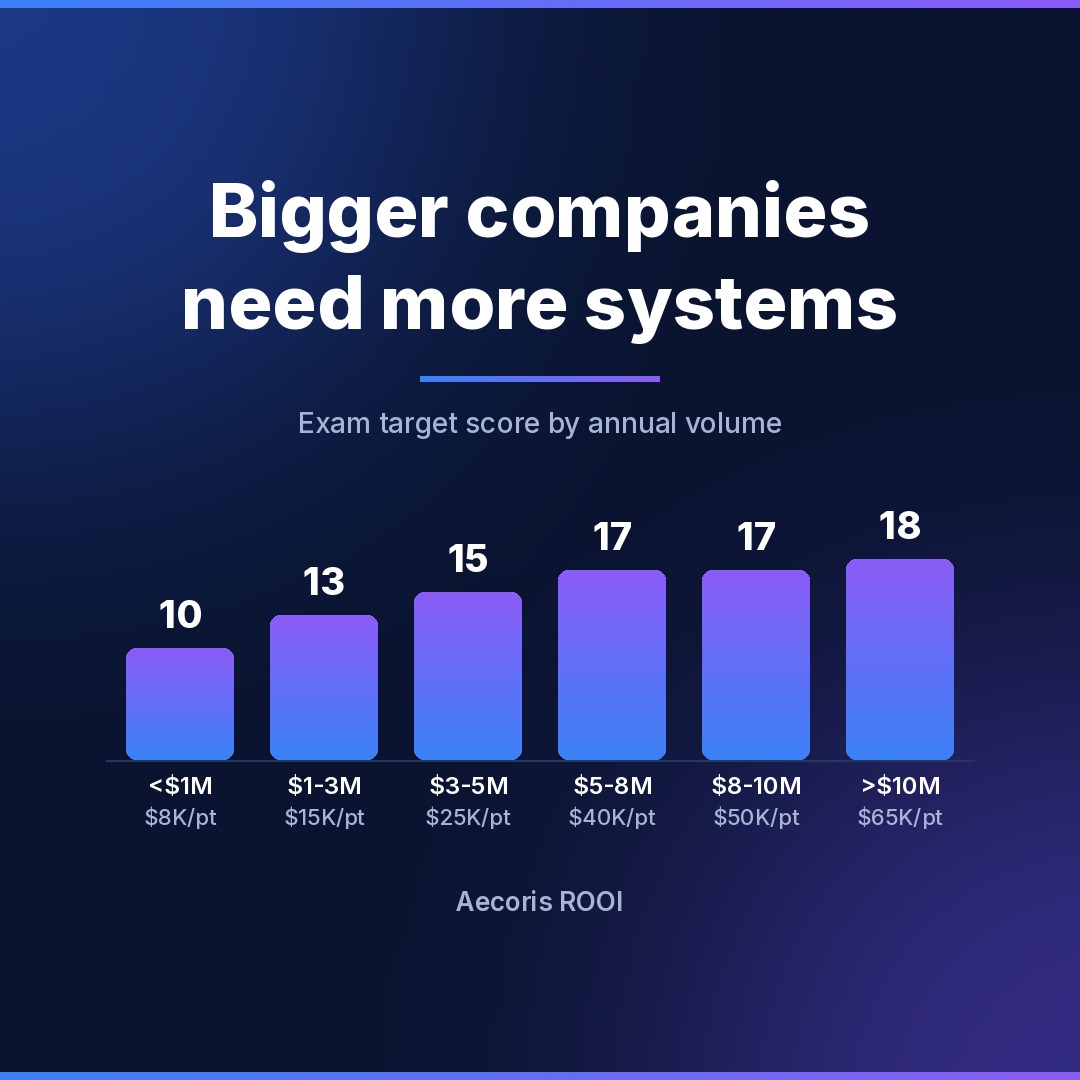
At $5 million to $8 million in sales, the ROOI exam puts $40,000 a year of pretax profit on each point.
That number surprises people. A yes or no on one question, worth $40,000 a year?
Here's how it works, and why the number rises as a company grows.
20 items, one score
The ROOI exam has 20 yes-or-no items in four areas: leadership, people, systems and outsiders. Each yes is a point. The questions ask about how the company runs. Do you have an annual budget? Is your markup policy written? Is labor reported against the estimate?
Plus one question about your sales volume, so you're compared with companies your size.
The target and the dollars rise with volume
The target score and the dollars per point both rise with volume:
- Under $1M: target 10, $8,000 a point
- $1M to $3M: target 13, $15,000 a point
- $3M to $5M: target 15, $25,000 a point
- $5M to $8M: target 17, $40,000 a point
- $8M to $10M: target 17, $50,000 a point
- Over $10M: target 18, $65,000 a point
An example
Here's an example. A $6 million company scores 13. Its target is 17.
Four points short at $40,000 each is $160,000 of pretax profit at stake every year.
That's not a promise that fixing four items will add $160,000. It's a way to put a dollar size on the gap, so you can decide which gaps are worth closing first.
Why the target rises
A small shop can run on the owner's memory. A bigger one needs systems.
When I started out, I knew every job, every customer and every number. I didn't need a written markup policy because I priced every bid. I didn't need a budget meeting because the whole budget was in my head.
That works at a small size. It stops working as the company grows. More jobs, more people, more decisions than one person can make. The things you used to carry in your head have to be written down, measured and shared. Read could your company run two weeks without you.
That's why a $10 million company needs more yes answers than a $1 million company.
Why the dollars rise
The dollars per point rise for the same reason. A missing system costs more in a bigger company.
A markup that drifts on a $1 million company costs a little. The same drift on a $10 million company costs ten times as much. A labor overrun nobody catches until closeout is a bigger number when the jobs are bigger.
What to do with your score
When you finish the exam, you see three things:
- Your score next to same-size firms
- The dollars of pretax profit at stake each year
- The first step to close each gap
Pick the gap with the biggest dollars and the easiest first step. Start there. Then come back in six months and take it again.
Not sure what the return on overhead even is? Start with what ROOI is, or figure yours in five minutes.
Use it to set priorities
The dollars per point are most useful for choosing what to fix first. Not every gap takes the same effort. A written markup policy can be done in a week. A bigger bank line might take two years. Start with the gaps that are worth the most and easiest to close, and build from there.
Find your number
The exam takes about 10 minutes. No spreadsheets to dig up. You answer from what you know about how your company runs today. The planner after it is free too.